Showing posts with label quirky. Show all posts

Tuesday, January 21, 2014

I learned a new word


Shinrin-yoku

It's Japanese.
shinrin = forest
yoku = bath

I gather the idea is to take a walk in the woods to refresh oneself and reduce stress. Some of us have always done that, but apparently it's a Thing now, like yoga or aromatherapy:

http://en.wikipedia.org/wiki/Forest_bathing
www.bbc.co.uk/news/science-environment-24806994
www.ncbi.nlm.nih.gov/pmc/articles/PMC2793346/

Saturday, October 19, 2013

Stained Glass at St. Saviour's

St. Saviour's Episcopal Church here in Bar Harbor is famous for its stained glass windows. There are 10 windows by Louis Comfort Tiffany, and another dozen or so by less-well-known artists. I spent some time there last week taking in the details.
Look how beautifully this artist painted the feathers within each pane of colored glass.
The shading on her face is so delicate!


I love the expressions on the fishes' faces - the artist gave them human eyes and profiles, which makes them subtly disconcerting.

Monday, September 30, 2013

The Black House (aka Woodlawn Museum)

On Saturday we visited Woodlawn Museum, which everyone I know calls The Black House, a reference to its former owners, the Black family. This is a local habit I find endearing - the tendency to refer to places by long-gone names. You'll get directions to "turn left at the cheese house" (the cheese house closed about thirty years ago) or "just past Crab Corner" (named for a crab-picking business that closed at least fifteen years ago) and so on. There's even a "Raggedy Ass Corner" where there was once a tumbledown old house with a yard full of junk (now heavily wooded with no trace of the house.) Polite people call it "R.A. Corner." I've picked up the habit myself, and still refer to our grocery store as "Don's" even though Don sold it to Hannaford years ago (as does everyone else who pre-dates that sale. It's one way to tell when people moved to town.)
But back to the Black House... The house was built by one Colonel John Black in the 1820s. The Black family lived there for three generations and left it to the town to be run as a museum in 1929. (And people still call it the Black House when it's been "Woodlawn" for 80-something years...I wonder if our house will ever be "the old Booher place.") 
The house is stuffed with the original furniture, china, rugs, knicknacks, and commodes. There's a lovely curving staircase in the central hall, which was impossible to photograph without a wider angle lens, and some interesting architectural features. There's also an enormous four-poster bed which we were told is the oldest bed in the U.S. that is still in its original room and has its original hangings, which is impressive, but I just couldn't get excited about that, because I have asthma and all I can think of when I see bed canopies is the dust mites.
This is not the famous bed, but it did make me think of dust mites.
The last owner, the third generation of Blacks, seems to have been caught up in the Colonial Revival movements of the 1880s and 1920s. I picture him poking through the attics looking for his grandparents' furniture (which was the genuine article) and polishing the family portraits of Generals Washington and Cobb (Cobb was an ancestor, Washington was a friend of his) before leaving the whole caboodle to the town of Ellsworth.
There are some wonderful portraits. I think that's General Cobb up above, and it might be Frances Black below, but then again, it might not. Whoever she is, isn't her lace collar amazing?
 A few last details from the house:
This is called a lithophane. It's molded ceramic, believe it or not, and the light shining through the thinner parts works kind of like a negative. Learn more here.

I don't often envy the original occupants of historic houses (have you ever tried to keep warm in a large room heated only by an open fireplace?) except in their pantries. I'm often consumed with jealousy over their storage. The Blacks had three sets of china, and according to the guide, the blue-and-white ware was for breakfast, the Canton ware (seen above) was for luncheon, and the um, other, more-colorful-set-which-did-have-a-fancier-name was for dinner. Three full sets of china and the shelves upon which to store them? Envy. And the other side of the pantry had three shelves of glassware. More envy. Turning green. Must go admire my indoor plumbing and pat my baseboard radiators.

Monday, January 7, 2013

La Noche de Rábanos, Oaxaca: December 23, 2012

La Noche de Rábanos, Night of the Radishes, Oaxaca de Juárez, Mexico
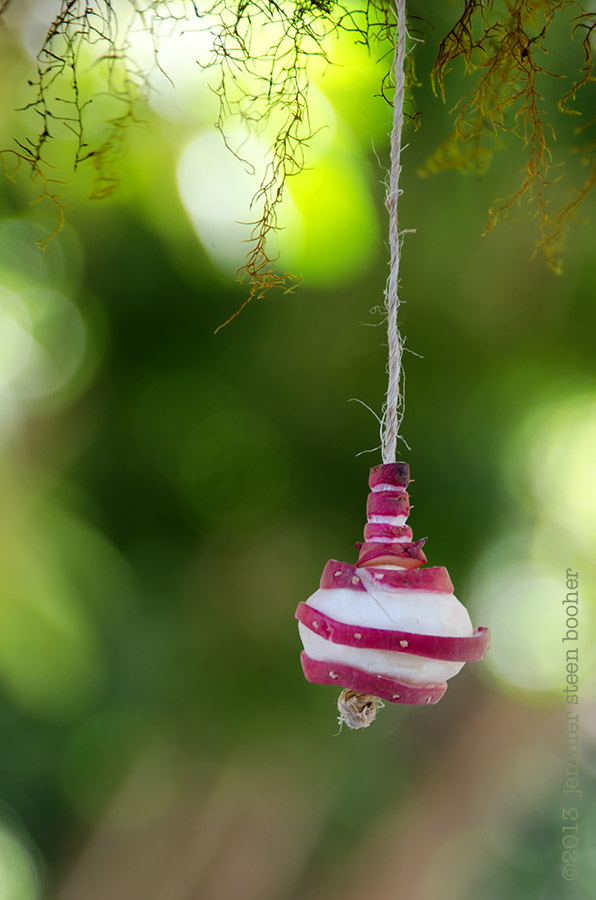
 Our first day in Oaxaca was the day before Christmas Eve, and in Oaxaca, that means radishes. December 23 is La Noche de Rábanos, or Night of the Radishes, and the participants line the main city square (called the Zócalo) with booths displaying elaborately carved scenes built of enormous radishes. The story I heard is that the Spanish introduced radishes in the 16th century, and some priests began carving them to make them more attractive at the market. The festival itself dates from the 19th century, and there is a cash prize for the winner (I think it was about $1000 this year.)
La Noche de Rábanos, Night of the Radishes, Oaxaca de Juárez, Mexico
Although the festival opens at 5 in the evening, my excellent guidebook firmly instructed would-be photographers to go early, so I dutifully trotted down to the Zócalo around 10am to watch the participants assembling their displays.
La Noche de Rábanos, Night of the Radishes, Oaxaca de Juárez, Mexico
The authors were absolutely right, too. Raised viewing platforms surround the display booths, and they are not opened to the public until evening, so with a good telephoto lens you can get clear shots of the work:
La Noche de Rábanos, Night of the Radishes, Oaxaca de Juárez, Mexico
 There were mild crowds watching the work proceed, but later in the evening, the square and the platforms were packed, and the line for the platforms went several times around the block:
 La Noche de Rábanos, Night of the Radishes, Oaxaca de Juárez, Mexico
So thanks for the tip, Viva Oaxaca!
La Noche de Rábanos, Night of the Radishes, Oaxaca de Juárez, Mexico
It was fascinating to watch the process of carving the radishes and sticking them together with toothpicks and string.
La Noche de Rábanos, Night of the Radishes, Oaxaca de Juárez, Mexico
The radishes dry out, so the exhibitors spray them frequently with water.
La Noche de Rábanos, Night of the Radishes, Oaxaca de Juárez, Mexico
 I'll close with a few details from my favorites: La Noche de Rábanos, Night of the Radishes, Oaxaca de Juárez, MexicoLa Noche de Rábanos, Night of the Radishes, Oaxaca de Juárez, Mexico

La Noche de Rábanos, Night of the Radishes, Oaxaca de Juárez, Mexico
I took a couple thousand photos in Mexico, of which I plan to throw away all but a couple hundred. Even with that rate of attrition they won't all fit here on the blog, so if you want to see more, come over to the 'Mexico' set on my Flickr page.

Friday, April 16, 2010

Greek Alphabet Blocks


Greek Alphabet blocks, originally uploaded by quercus design.
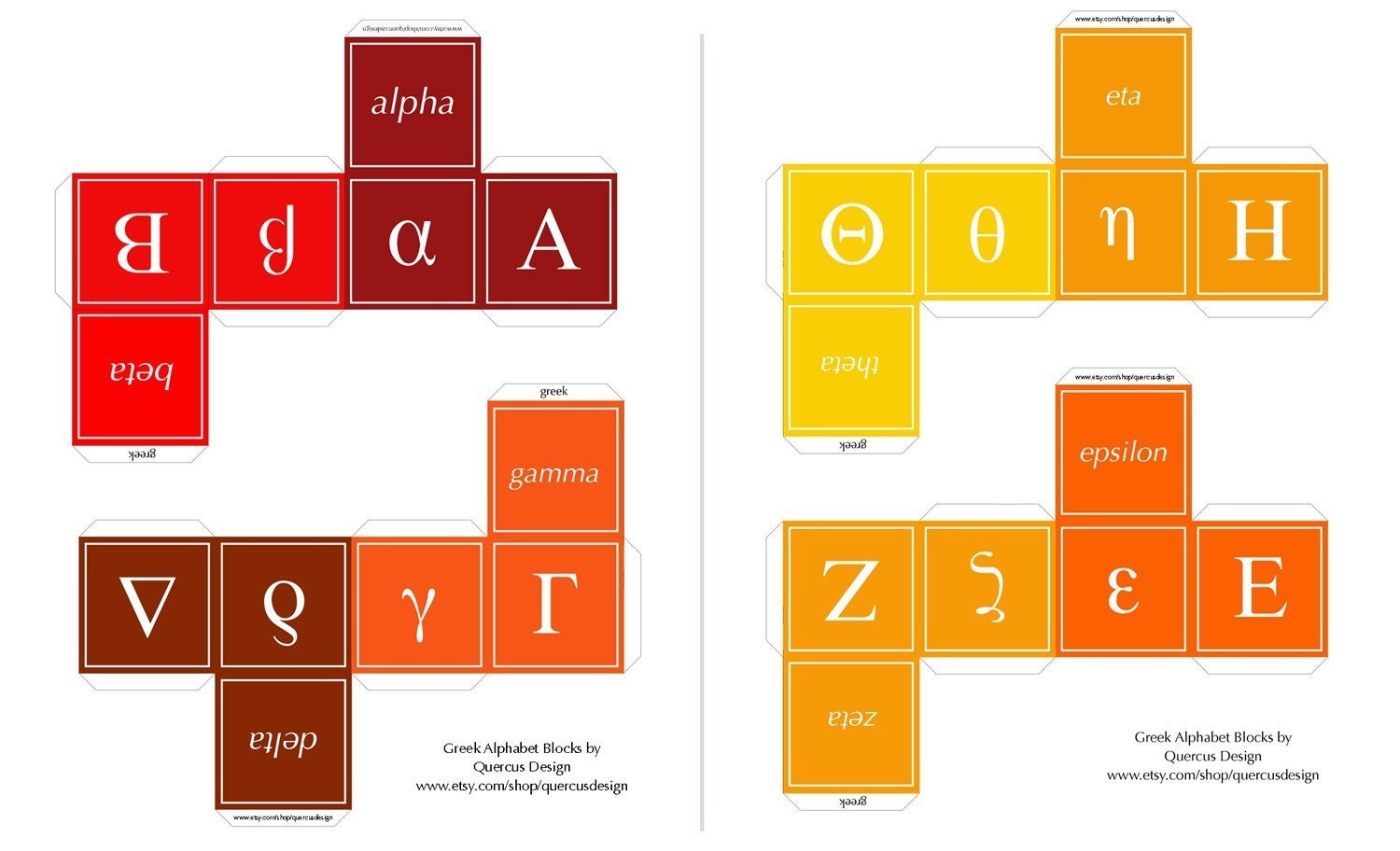
Yes, alphabet blocks, in Greek! Doesn't everyone in America need a set? This was last year's Christmas present for my nephew.* I designed them in Photoshop, then laser-printed on matte photo paper, cut and folded. (Sounds easy, right? The trick word is 'Photoshop.' Nothing is actually easy in Photoshop.) Scroll down for instructions for printing and assembly. I'd love your feedback!
https://www.etsy.com/listing/63420239/greek-alphabet-block-printable-alpha-to

Design Process
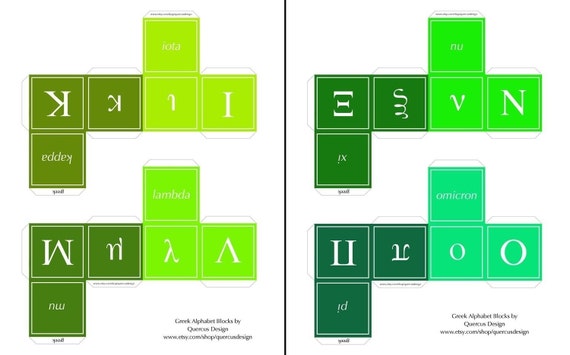
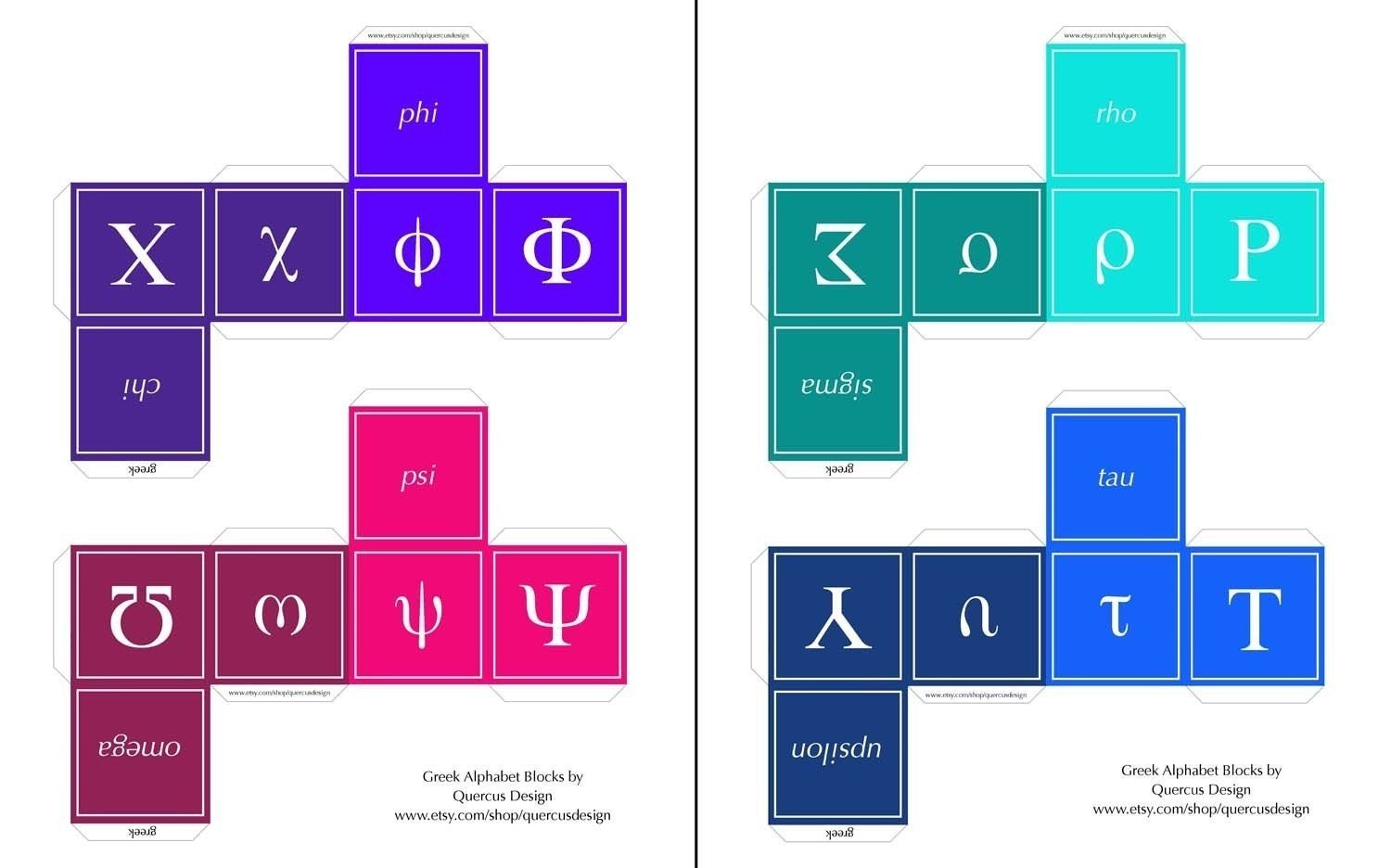
The structure was simple, just a basic box scaled to the size of a typical alphabet block. Figuring out how to present the characters was something else! (I guess that 'something' would be Graphic Design.) I wanted 2 characters per block, so the set would be compact. Each character has an upper and lower case version, and a name (you know, like Alpha or Omega.) I struggled to find a simple way to show which characters went with which name, eventually using color to differentiate the characters, and the location of the name to orient them.
https://www.etsy.com/listing/63420239/greek-alphabet-block-printable-alpha-to


See how kappa is a different color from iota, and how if iota is the topmost face of the block, the iota characters are right side up and the kappa characters are upside down? That took a really long time to figure out, and even longer to implement. So I'm rather pleased with myself for pulling it off.


Printing
1. You can purchase the full-size templates for $5 in my etsy shop (click on a photo and it will take you there), and you can print as many copies as you like from them for personal use. I think you can print from this blog, too, although the quality may not be very good.
2. I used HP matte Color Laser Photo Paper which is nice and thick (but hard to find. I got mine from Amazon.) Any lightweight white cardstock should work, though. You can even use regular printer paper, but the blocks will be delicate.
3. Print at the highest resolution setting you have, and make sure your page setup is on landscape or you'll get teeny weeny blocks.
https://www.etsy.com/listing/63420239/greek-alphabet-block-printable-alpha-to


Assembly
The more obsessive you are about assembly the better the blocks look, so here are some tips:
1. Use a fresh, sharp x-acto blade, a metal-edged ruler, and a cutting mat.
2. Cut right on the line, not on one side of it.
3. Score the folds so you'll get nice sharp edges. [If you've never scored paper: You want something with a fairly small head, pointy but not sharp, and strong enough to press hard on. (I used a tiny metal crochet hook, which was kind of painful. A dried-out ballpoint pen might work. Let me know what you use.) Set your metal ruler along the fold line and run your thingumy along it, pressing hard to make an indented line.]
4. Crease along each fold line once before starting to glue. It is much harder to get a nice crisp fold later.
5. I use a dab of Elmers on each tab and level it with an old credit card, but if you are a sophisticated modern sort, double-stick tape might work great. (Again, I'd love to know what you use.)
6. Don't build anything with them until the glue dries!
It is amazing how sturdy they are. I mean if you stepped on one you'd crush it, but I've got hordes of 3rd- and 6th-graders rampaging through my house regularly, and these are none the worse for being used as Nerf targets, bunny-maze walls (real live bunny, folks), and attempts to write names and rude words in Greek.
In fact, we had so much fun once the painfully tedious parts were over I'm thinking about doing another set in Cyrillic. Or Hindi. Or Klingon! What do you think?

Post pics, please: I want to see what you make! (If you want to use this as a template to make your own set, no problem, just give me credit for the design and a link to this post, OK? Oh, and don't sell it. Please.)
-------------------------------
10/2/10: I have finally changed the template to 'alpha' instead of 'aleph.' Sorry about that. Doesn't everyone get their Phoenician and Greek mixed up sometimes? The photo of the completed blocks still shows 'aleph' because I haven't gotten around to building the new block and re-photographing.

*I don't know what he thought of them. I have a peculiar sense of humor and can't help sending really odd gifts sometimes, so I assume if no one mentions a present that it caused general bewilderment on the receiving end, is now on the shelf at Goodwill, and it is best for everyone if we just don't mention it. Everyone needs a crazy aunt, right?
**On the other hand, my own kids wouldn't leave the prototypes alone, and when Percy Jackson mania hit this spring all my son's friends started messing around with them.